Warm Enough for Whom? Settling the Cottage Heating Question Before You Arrive
There's a particular silence that settles over a cottage on the first evening, somewhere between dragging the bags in and locating the corkscrew. It's the silence of four adults standing in front of a boiler, each one quietly certain they know what the little dial means. Someone says it's a bit nippy in here. Someone else says it'll be fine once the fire's going. And so begins the weekend's first small negotiation, conducted in socks.
It doesn't have to be like this. Heating is one of the few cottage variables you can genuinely plan around, and doing so takes about ten minutes of thinking before you book. What follows is the approach we'd recommend to anyone travelling with a mixed group — the ones who run hot, the ones who run cold, and the one who insists they're fine while wearing a scarf indoors.
Cosy is a personal setting
Here's the thing nobody says out loud: there is no correct indoor temperature. There's only the temperature the person paying for the logs thinks is correct, and the temperature the person who sleeps with the window open thinks is correct, and the two are rarely friends.
A thermostat set to 19°C is balmy to one guest and distinctly brisk to another. Neither is being difficult. Bodies differ, circulation differs, and a cottage's own quirks — thick stone walls, a draughty sash window, a room that never quite catches the sun — do the rest. The trick is to agree, in advance, that nobody is going to win outright. Aim for comfortable rather than tropical, and let layers do the rest.
Read the controls before the instructions
Most cottage heating falls into one of a handful of camps, and knowing which one you've booked changes how you pack.
Central heating with a room thermostat is the straightforward case. Usually there's a programmer somewhere (airing cupboard, kitchen cupboard, occasionally a hall) plus thermostatic radiator valves on each rad. Turn the valves up in the rooms you're using, down in the ones you aren't, and leave the main thermostat alone once it's set. Cranking it to 25 won't heat the place faster; it just means the boiler keeps running after everyone's too warm to think.
Night storage heaters are a different animal — common in rural cottages, and often on an Economy 7 tariff. They charge overnight and release heat through the day, which means they're lovely by mid-afternoon and rather less generous at seven in the morning. If that's what you've got, use the boost setting sparingly and don't expect instant results. Plan around the heater, not against it.
Oil-fired ranges and Agas are their own small religion. Some run the hot water, some do the cooking, and some do both on a schedule the owner has spent years perfecting. Don't fiddle unless you've been told you can. A warm kitchen with an Aga in it is one of the great winter pleasures; a cold one because somebody switched it off is not.
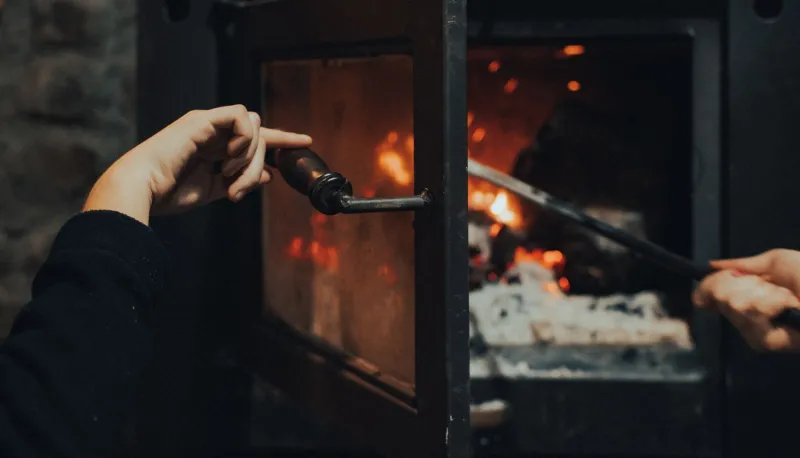
Wood burners and open fires are the ones people book cottages for, and the ones most likely to disappoint on night one. Ask, specifically, whether logs, kindling and firelighters are provided and whether they're included in the price. A basket of logs that lasts one evening is a particular kind of tease.
The questions worth asking before you book
None of these are awkward. Owners would far rather answer them than field a phone call at ten at night.
- Is the heating controllable by guests, or on a fixed timer?
- Is there a wood burner, and is fuel supplied?
- Are all bedrooms heated, including the small one under the eaves?
- Is there an electric blanket, hot water bottles, or a spare duvet in the cupboard?
- Is there anywhere to dry wet coats and boots?
That last one matters more than people expect. A cottage with a proper drying room or a heated airing cupboard is a materially different proposition in January from one without. If you're walking in winter, it's arguably as important as the bed.
Pack for the gap
The gap is the distance between what the owner considers warm and what your particular group considers warm. You can close most of it with a bag that weighs almost nothing: a base layer each, thick socks, a jumper you'd be happy to be seen in, and slippers. Add a hot water bottle if there's any doubt — it costs nothing and has settled more first nights than any thermostat.
This isn't about packing defensively. It's about not spending the first evening in a low-grade sulk because the sitting room is 17°C and someone has decided to make it everyone's problem.
The first night, sorted
Arrive, put the kettle on, and give the place twenty minutes before you judge it. Cold walls take time to lose their chill, and a cottage that felt unwelcoming at four o'clock often feels entirely different by six.
Set the thermostat to something moderate and leave it be. Close the curtains at dusk — that single habit does more for a winter cottage than most people realise. Don't drape wet towels over radiators. If there's a fire, lay it early and let it build rather than fighting it at bedtime. And if something genuinely doesn't work, ring the owner that evening rather than fuming quietly until Sunday.
Above all, say the thing out loud. 'I'm a bit cold, shall we put the heating on for an hour?' is a perfectly ordinary sentence and a far better use of a weekend than three days of silent thermostat warfare. The truce isn't about who wins the dial. It's about everyone getting to the pub warm.